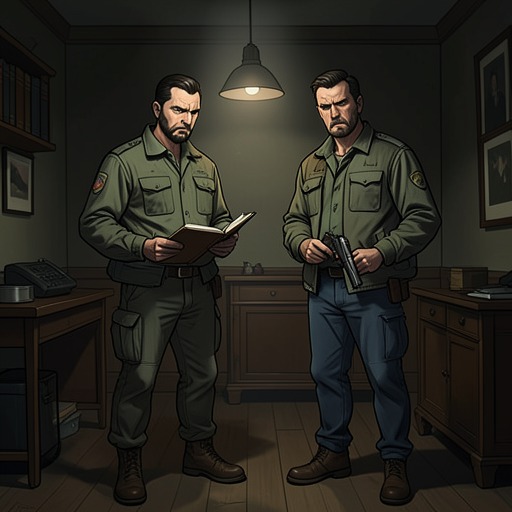
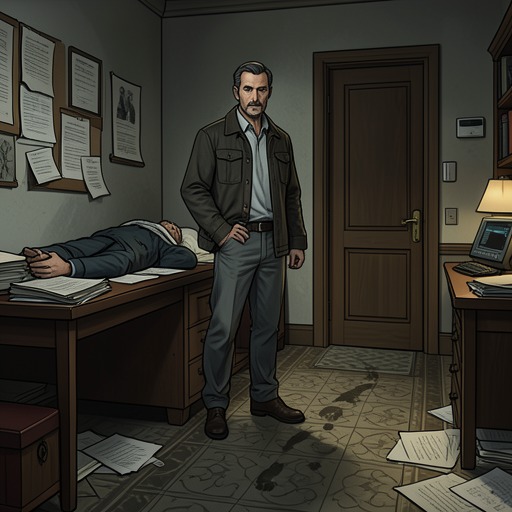
Death of Cadet Leroy Fry
The Pale Blue EyeThe Death of Cadet Leroy Fry begins with a blunt report of a hanging and becomes a forensic puzzle: the marks on Fry’s body suggest struggle, while the missing heart makes the apparent suicide impossible to accept at face value. Through Augustus Landor’s retrospective account, the event’s first force comes from the collision between an official-sounding conclusion and physical evidence that refuses to fit it.
Discovery and First Impressions
Captain Hitchcock tells Landor that Leroy Fry hanged himself the previous night. The news is delivered in the presence of Sylvanus Thayer, whose steady attention to Fry gives the announcement the weight of a matter already under close scrutiny. Landor registers the strange sense of having arrived at either the end or the beginning of a larger joke, then offers his sympathy; the uncertainty in that reaction anticipates the investigation’s challenge to the first account of Fry’s death.
The next morning, Landor and his companions are led through the new West Point hospital to Ward B-3. The hospital is ordinarily ready to receive visitors, but the scene has unsettled its staff: one matron has fainted, while the other, too harried to explain, leads them upstairs, draws the linen sheet from Fry’s body, and leaves them alone. The body lies on a blacksmith bed beside an open fireplace. This clinical setting, newly scrubbed and orderly, offers no protection from what the sheet reveals.
Fry’s hand rests at his groin, the other is clenched, and his eyes remain half open. His mouth is twisted, two yellowish front teeth jut from his upper lip, and his neck is marked red and purple with black streaks. His chest has been torn or opened, its surface showing several different shades of red. Landor’s first comparison is to an immense concussive force, a conjecture that registers the violence of the wounds rather than establishing their cause. At this stage, the visible injuries are horrifying but not yet an explanation.
A closer examination gives the neck marks a different meaning. Landor pulls Fry’s eyelids down, but they spring back up; then he traces the lacerations and recognizes that the rope has not left one simple band. It has gouged and chafed back and forth, forming a weave along the neck. Landor reasons that this damage accumulated before the noose finally closed Fry’s windpipe. When he asks whether the searchers are looking for a man or a heart, Hitchcock can report only that the grounds have been searched and nothing found. The absent heart thus enters the inquiry alongside the rope marks: the hanging may describe how Fry was found, but it does not settle how he died.
Reconstructing the Hanging
Landor tests the suicide explanation against the circumstances it would require. If Fry had chosen to die, Landor reasons, he might have left a note to explain himself and make his unheard grievances known. No note has been found. Nor does the body appear to him to have reached the tree by a simple, voluntary route: the marks on Fry’s neck and hands suggest resistance, while the position of his feet raises the possibility that he died with them still on the ground. Each point is an inference, not a complete reconstruction, but together they make the easy account increasingly difficult to sustain.
To demonstrate what the rope marks might mean, Landor removes his jacket, rolls up his sleeves, and plunges a hand into the alcohol bath. He hauls Fry’s head toward the surface; the stiff body rises with it, and Landor has to brace it with his other hand to keep it from sinking. Examining the neck, he emphasizes that the rope did not leave a clean, even cinch. It had run up and down, catching and scraping for a hold. Landor reads this irregular track as evidence that Fry fought the noose rather than calmly placing himself in it.
The hands and the back of the head add further questions. Dr. Daniel Marquis identifies a contusion, a raised lump roughly a quarter inch above the skull. Landor asks whether it might have been inflicted after death. Dr. Daniel Marquis explains that a bruise forms when blood escapes from its vessels, and that without circulation such bruising is not likely. The distinction matters: if the contusion formed while Fry was alive, it cannot be dismissed as damage caused after his death or during later handling. It points to an injury sustained before the hanging was complete, though it does not identify who caused it.
Landor lays the facts out for Captain Hitchcock and Dr. Daniel Marquis: Fry had told no one he wished to die, left no note, apparently died with his feet on the ground, and bore a head contusion, blisters on his fingers, and rope burns running along his neck. His question is not yet who killed Fry, but whether these circumstances describe a man going willingly to his death. When pressed to state what he believes happened, Landor offers a provisional theory: someone struck Fry on the back of the head, put the noose around his neck, and pulled it tight. He marks this as a theory rather than proof. The investigation has overturned the certainty of suicide without yet supplying a named assailant, a motive, or a fully recoverable sequence of events.
A Later Contrast with Ballinger
In a later review of the two bodies, Landor asks a witness who had seen both what distinguished Randolph Ballinger’s condition from Leroy Fry’s. The clearest difference was height: Ballinger had been found hanging much higher than Fry, with his feet off the ground. His wounds were already on him when the body was discovered; he had been killed and cut open before being strung up. The height made it nearly impossible for those injuries to have been inflicted afterward, and the hanging could not plausibly have been a suicide. The comparison sharpens the significance of Fry’s low position and the marks of resistance on his neck, while keeping the two deaths from being treated as identical scenes.
The later account also shows how much remained uncertain at a crime scene. Ballinger’s tree stood about three hundred yards from his sentinel post, and the witness could not tell whether Ballinger had come there willingly, been dragged, or was alive when he arrived. A storm had churned mud and snow under the feet of many soldiers, leaving tracks that could not be distinguished. This contrast does not identify who killed Fry or supply a complete account of his final movements; it instead places the hanging within an investigation where physical evidence could overturn appearances, but damaged scenes and missing traces still limited what could be proved.
The Missing Heart and the Limits of the Case
The search for Fry’s heart gives the investigation a second question alongside who may have killed him: what was done to his body after or around his death? Landor’s distinction between searching for “A man? Or a heart?” refuses to let the hanging account stand as a complete description of the event. Yet the missing organ does not, by itself, identify its remover or explain the purpose of its removal. Fry’s death therefore remains an evidentiary threshold rather than a solved case: the physical signs make a simple suicide account untenable, while the absent heart points toward an additional act whose agent and meaning must still be established.